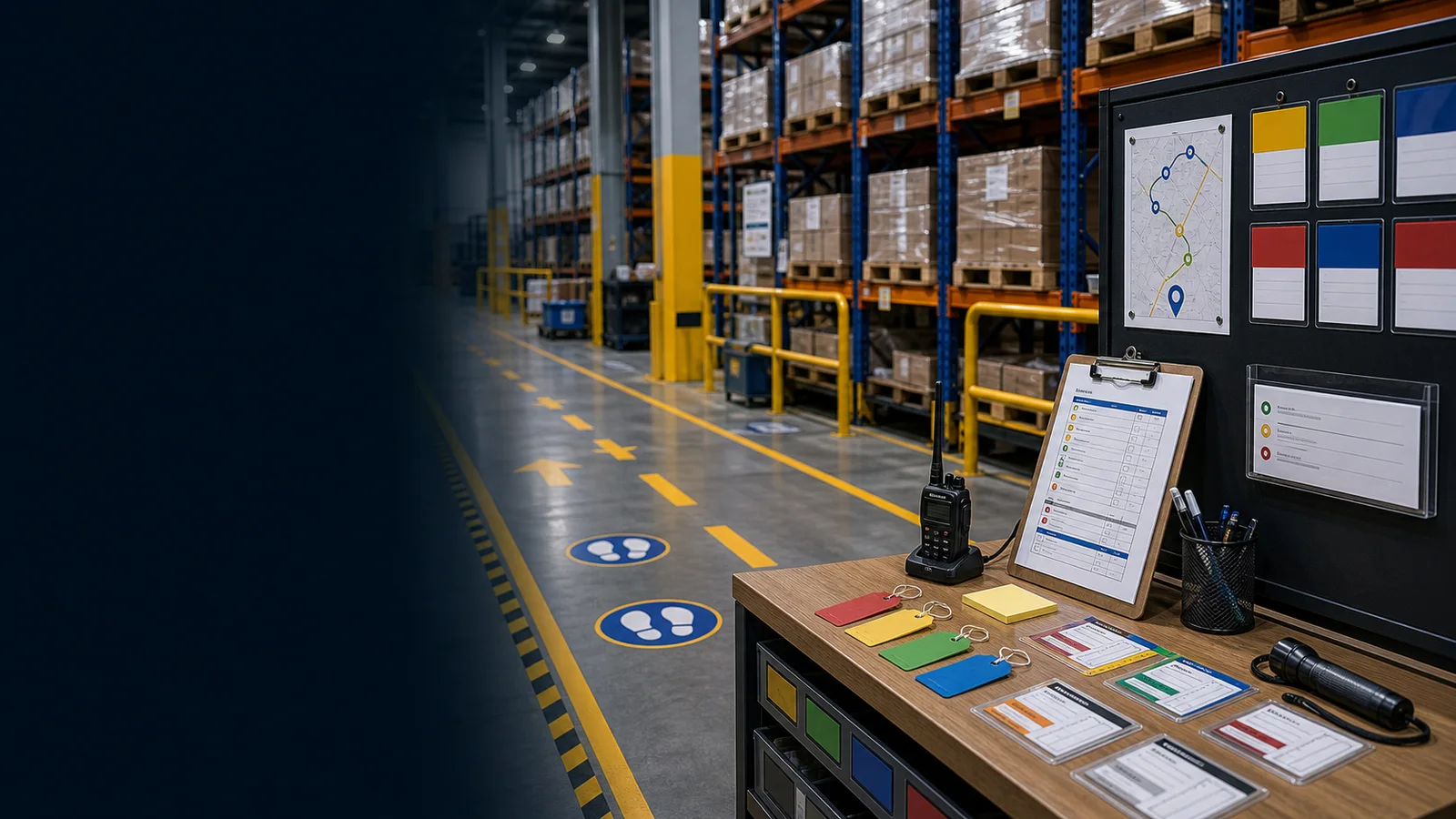
The Warehouse Framework by Alexandru Valentin Sirbu
Supervisor Walk (Gemba) — Safety • Gemba • Improvement • Checking warehouse framework photo

Framework

Supervisor Walk (Gemba) — Safety • Gemba • Improvement • Checking

Use this framework for daily/weekly leader walks: protect safety first, verify standards, expose flow issues, coach people, and drive visible improvements. Track completion per pillar, capture notes and decisions, and export to Markdown/JSON. Data saves locally in your browser.

Overview

What this framework standardizes

Supervisor Walk (Gemba) — Safety • Gemba • Improvement • Checking is designed for warehouse teams that need a clear operating method, not just a theoretical document. It explains what supervisors, team leaders, operators, and support functions should look for on the floor, how to convert observations into action, and how to keep the standard alive after the first rollout.

The page focuses on Workflow Clarity (Gemba), Assessment (Checking), Requirements (Standards), Education (Safety & Skill), Hands-On Problem Solving (Improvement), Observation (Safety Behaviors). These topics help teams align language, reduce variation, and build a repeatable routine that can be audited, trained, and improved over time.

Use this framework as a working reference during shift meetings, Gemba walks, onboarding, improvement workshops, SOP reviews, and daily performance follow-up. The goal is to make the right behavior visible, simple, and repeatable.

6Focus areas
53Floor checks
4Rollout phases

Framework Detail

Operating pillars and practical checks

Each pillar combines a clear intent with practical checks. Use the intent paragraph to explain the standard, then use the checks as audit points, training prompts, or action-plan inputs.

W

Pillar 1

Workflow Clarity (Gemba)

Walk the actual flow: ship → pick → replenish → inbound. Follow one pallet/order end-to-end; verify visual controls are visible and used.

  • Walk ship → pick → replenish → inbound without skipping waiting/bottlenecks

  • Trace one live unit end-to-end and time each handoff

  • Verify lane IDs, cone colors, and WIP caps are present and readable

  • Check that cone/label status matches the actual state of the unit

  • If unit is waiting: identify the blocker and next owner

  • Capture 2–3 photos at handoffs; log one flow win and one loss for the huddle

A

Pillar 2

Assessment (Checking)

Run 10–20 stable checks across Safety → 5S → Quality → Flow → People → Equipment. Mark Yes/No/N/A; set severity (Low/Med/High/Critical).

  • Safety: aisles clear; PPE in use; guards/LOTO in place; emergency access clear

  • 5S: borders/labels posted; red-tags dated; waste removed; no mixed SKUs

  • Quality: correct labels; wrap quality OK; scan compliance; counts match WMS

  • Flow: WIP under cap; aging flagged; dock-to-stock within target

  • People: staffing at plan; cross-trained coverage; mentor pairings active

  • Equipment: trucks charged; scanners functional; racks undamaged

  • Record Yes/No/N/A and root cause; apply severity (L/M/H/Critical)

  • Treat cone/status mismatches as process defects; coach on the spot

  • Log defects for weekly trending and recurrence control

R

Pillar 3

Requirements (Standards)

Anchor findings to SOP/WI, LOTO, and visual standards (cones, labels, borders). If no standard exists, raise a standard-creation action (owner + due).

  • Link each gap to the exact SOP/WI clause or visual rule

  • Post cone legend and WIP cap limits at point of use

  • Remove outdated/conflicting visuals immediately

  • If standard is missing: raise standard-creation action with owner & due date

  • Confirm updated standards are communicated at next stand-up

E

Pillar 4

Education (Safety & Skill)

Deliver a 3-minute, point-of-work micro-lesson. Capture a photo and pin a one-point lesson to the area board. See-one → do-one coaching for new leads.

  • Run a 3-minute micro-lesson in the area (safety/skill)

  • Reinforce cone meanings and the “status lives with the item” rule

  • Coach safe forklift spacing and horn use in shipping lanes

  • Demonstrate correct film wrap tension and top-cap application

  • Capture a photo and post a one-point lesson on the area board

  • Pair a new lead for see-one → do-one coaching

H

Pillar 5

Hands-On Problem Solving (Improvement)

Fix now when safe; formalize the rest. Separate containment (make safe) from corrective (prevent recurrence). Assign owner/date and verify in next walk.

  • Tier 0 (Now): remove hazard, relabel, re-stage, re-cone to correct status

  • Tier 1 (Same shift): quick 5-Why and simple poka-yoke (visual, label, guide)

  • Tier 2 (Cross-team): Kaizen ticket for systemic change (IT/WMS, layout, policy)

  • Always separate containment vs corrective; assign owner and due date

  • Verify completion and effectiveness on the next walk

  • Update standard/SOP and visual if the fix changes the method

O

Pillar 6

Observation (Safety Behaviors)

Weekly behavior observations (driving, lifting, scanning, wrapping). Track % safe behaviors; coach privately, recognize publicly.

  • Complete 5–10 short observations per week per area

  • Observe: driving, lifting, scanning, wrapping; one behavior at a time

  • Close each observation with either reinforcement or correction

  • Track % safe behaviors; share at stand-up

  • Coach privately; recognize publicly (shout-outs for safe behaviors)

U

Pillar 7

Updating (Keep It Current)

Weekly visual audit: cones, labels, 5S borders, boards up to date. Version control SOPs (title, owner, date). Remove outdated visuals.

  • Audit cones, labels, borders, and area boards are present and current

  • Ensure cone legend & WIP cap postings at each relevant area

  • Verify SOP/WI version control (title, owner, date) is visible

  • Remove retired procedures/visuals on the same day

  • Schedule refresh where dates exceed policy thresholds

S

Pillar 8

Support (Unblock & Resource)

Clear top 3 blockers (tools, staffing, IT/WMS access, spares). Fast path with EHS/QA/Maintenance for High/Critical items. Recognize good catches.

  • Name today’s top 3 blockers and assign owners with due dates

  • Engage EHS/QA/Maintenance immediately for High/Critical items

  • Confirm spares/tools/IT access for the area are adequate

  • Escalate staffing gaps or coverage issues to the tier meeting

  • Recognize clean handoffs and good hazard catches

E

Pillar 9

Evaluation (Results)

Review a small set of metrics weekly; drive out repeat issues.

  • Safety: recordables, near misses, unsafe → corrected %

  • Flow: on-time ship %, dock-to-stock, WIP age (FISH)

  • Quality: mis-picks per 1,000 lines, rework %

  • 5S/Discipline: 5S score, red-tag closure ≤ 7 days, action on-time %

  • Trend weekly; kill repeat issues with corrective + verification

  • Publish a one-page trend view on the area board

Implementation

How to implement this framework without creating another unused document

01

Diagnose

Understand the current condition

Compare the current warehouse process with the Supervisor Walk (Gemba) — Safety • Gemba • Improvement • Checking standard. Look for unclear ownership, missing visual controls, repeated questions, rework, waiting time, safety exposure, and places where teams rely on memory instead of a visible rule.

02

Design

Translate the framework into local rules

Turn the guidance into simple local standards: who owns the routine, when it is checked, which evidence is required, and what escalation path is used when the expected condition is not met.

03

Deploy

Train, test, and improve on the floor

Pilot the standard in one area first. Train the team with examples, gather feedback, remove friction, and then expand once the routine works under real workload pressure.

04

Sustain

Review results and prevent drift

Add the topic to daily or weekly management cadence. Track open actions, check whether the standard is still visible, and update SOPs, work instructions, or visual controls when the operation changes.

FAQ

Common questions about Supervisor Walk (Gemba) — Safety • Gemba • Improvement • Checking

What is Supervisor Walk (Gemba) — Safety • Gemba • Improvement • Checking?

Use this framework for daily/weekly leader walks: protect safety first, verify standards, expose flow issues, coach people, and drive visible improvements. Track completion per pillar, capture notes and decisions, and export to Markdown/JSON. Data saves locally in your browser.

How should a warehouse team use Supervisor Walk (Gemba) — Safety • Gemba • Improvement • Checking?

Start with a short review of the current process, select one pilot area, apply the relevant checks, and assign owners for every gap. The page works best when it is used during real floor observation, not only as office documentation.

Why is Supervisor Walk (Gemba) — Safety • Gemba • Improvement • Checking important for warehouse operations?

It reduces ambiguity and makes execution more consistent. A clear framework helps teams train faster, detect abnormal conditions earlier, and protect improvements from disappearing after volume, staffing, or layout changes.

How often should Supervisor Walk (Gemba) — Safety • Gemba • Improvement • Checking be reviewed?

Review it during implementation, then include the key points in daily or weekly leadership routines. A deeper review should happen after incidents, layout changes, SOP updates, audit findings, or repeated performance issues.

Created by

Alexandru Valentin Sirbu