Green
RAL 6024#26A269
Use: Egress routes, first-aid access, safe pedestrian continuity
Rule: Reserved for safety. Use 100 mm for critical lines.
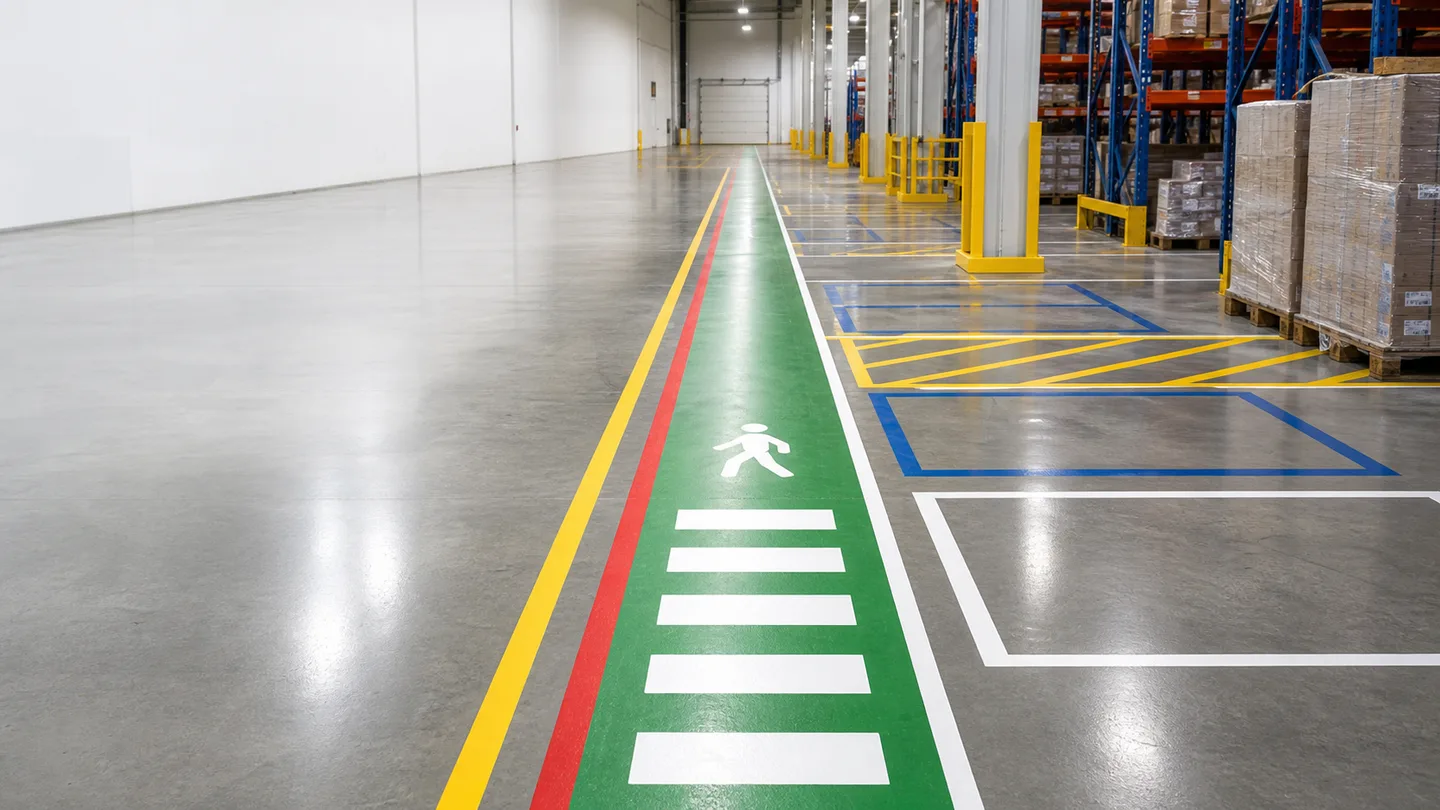
Warehouse Visual Standard
This is the unified floor coding system for routes, hazards, staging, and operational control. Use one language across the entire site and keep teams aligned shift after shift.
Line Width
75 mm standard, 100 mm primary/emergency.
Zebra Rule
300 mm bars, 300 mm gaps, anti-slip coating.
Hatching
45 degree hatch, 200 to 300 mm spacing.
Text Labels
Minimum 100 mm cap height in key zones.
#26A269
Use: Egress routes, first-aid access, safe pedestrian continuity
Rule: Reserved for safety. Use 100 mm for critical lines.
#CC0000
Use: Fire assets, emergency stop zones, no-storage boundaries
Rule: Pair with white in keep-clear fire zones.
#F7B500
Use: Caution zones, warning borders, attention markers
Rule: Use yellow-black for hazard emphasis.
#0072CE
Use: Operator flow lanes, process movement, task guidance
Rule: Primary Lean flow color across normal operations.
#9B1D6A
Use: Staging, supermarkets, controlled process inventory
Rule: Use for material control where ownership is defined.
#F44611
Use: Utilities, temporary engineering or special service zones
Rule: Keep only for technical and maintenance signals.
#919BA3
Use: Equipment parking, trolleys, non-critical asset home positions
Rule: Do not use for emergency, fire, or egress coding.
#FFFFFF
Use: Labels, arrows, text overlays, edge contrast
Rule: Support color readability and direction cues.
Use: High-risk collision points and hazard borders
Standard: 45 degrees with strong contrast, no mixed alternatives
Use: Fire keep-clear zones and door swing no-block areas
Standard: Red-white repeating pattern with clear text label
Use: Pedestrian crossings over traffic paths
Standard: 300 mm bars and 300 mm gaps, anti-slip topcoat
Use: Emergency route continuity and safe exit direction
Standard: 100 mm dashed lines with consistent gap lengths
Green boundaries with black-white zebra crossings where people intersect traffic.
Blue directional flow with white arrow overlays for clear one-way movement.
Yellow-black warnings and red-white keep-clear areas around high danger points.
Grey home positions for assets to prevent drift and blocked routes.
High-contrast text and symbols at risk interfaces, doors, and blind corners.
Violet and blue process lanes to separate staging from movement.
Orange coding for utility access, maintenance zones, and restricted interventions.
Monthly audits, defect logs, and refresh cycles to keep the legend alive and trusted.
Progress: 0 / 4 complete
FAQ
A warehouse floor color legend is a standardized rulebook for colors and patterns used on the floor so every team interprets zones, risks, and routes the same way.
Standardization removes ambiguity, improves safety behavior, accelerates onboarding, and prevents local improvisation that creates incidents.
Green should remain reserved for safety and egress lines, first-aid access, and protected pedestrian continuity.
Red and white should be used for keep-clear fire zones, door swing arcs, and any area that must never be blocked.
A common standard is 300 mm black-white bars with 300 mm gaps, designed for high visibility in traffic intersections.
A practical standard is 75 mm for normal markings and 100 mm for primary or emergency routes.
No. A controlled palette must be consistent site-wide; local variations reduce trust in visual management and create safety risk.
Review monthly in active operations and after every layout change, process change, or safety incident.
It supports visual management, location discipline, abnormality detection, and sustainment routines required by 5S and Lean systems.
Include zoning map, color standard, dimensions, paint specs, ownership, installation schedule, and audit checklist.
Yes. Temporary zones can use temporary materials but should still follow the same visual standard language.
Use durable coatings, anti-slip finishes where needed, routine cleaning, and scheduled refresh based on wear.
Created by
Alexandru Valentin Sirbu