The Warehouse Framework by Alexandru Valentin Sirbu
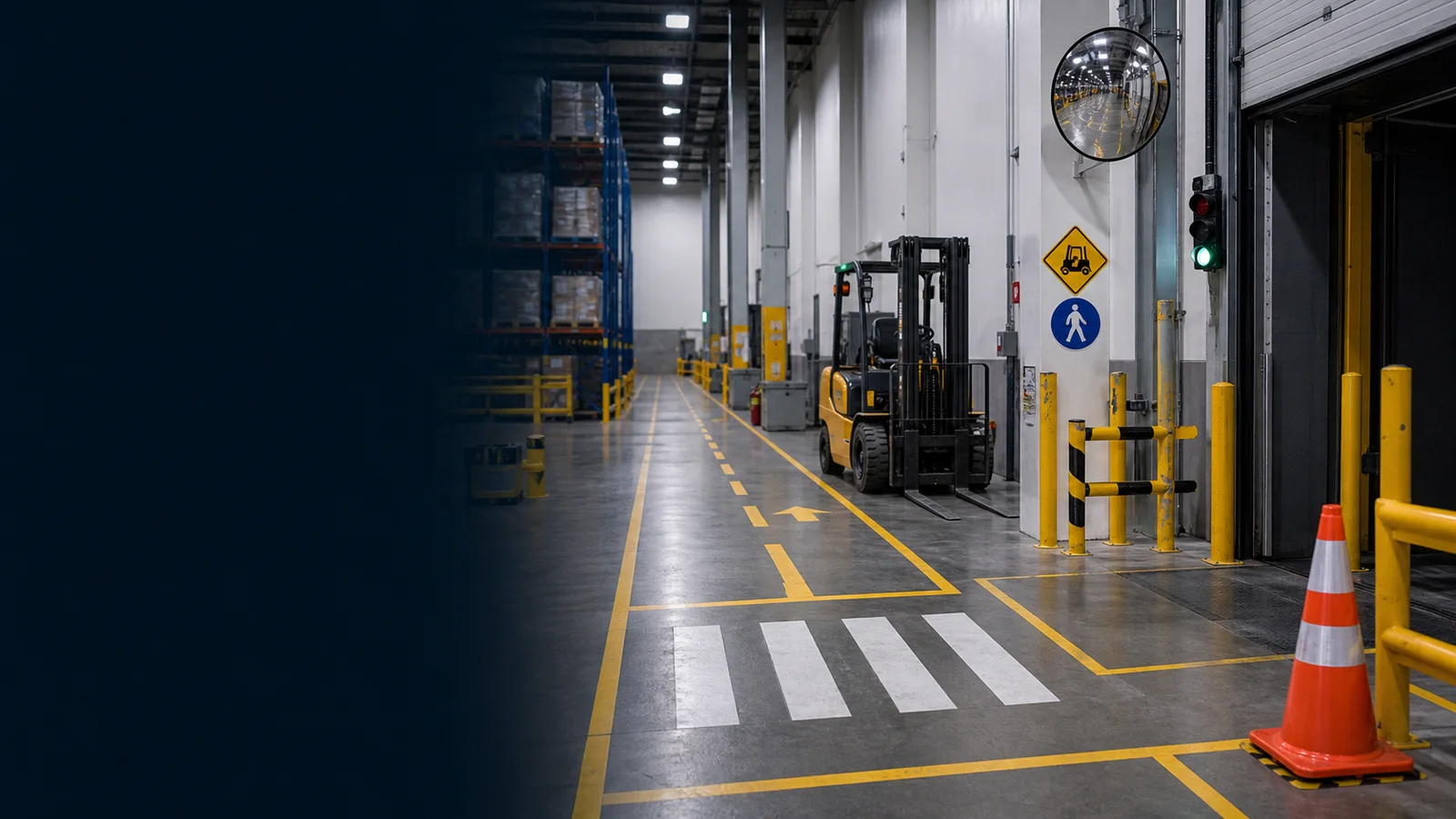
Forklift Traffic Management Guide warehouse framework photo

Framework

Forklift Traffic Management Guide

Turn your warehouse into a predictable, low-risk traffic system. Start by walking the floor to map live routes and pinch points. Assess risk by area and task. Set rules/right-of-way that people can remember and enforce. Engineer controls (markings, barriers, mirrors, lighting, speed governance). Hands-on train &...

Overview

What this framework standardizes

Forklift Traffic Management Guide is designed for warehouse teams that need a clear operating method, not just a theoretical document. It explains what supervisors, team leaders, operators, and support functions should look for on the floor, how to convert observations into action, and how to keep the standard alive after the first rollout.

The page focuses on Walk the Floor (Map Routes), Assess Risk & Demand, Rules & Right-of-Way, Engineer Controls, Hands-on Training & Licensing, Observe Behavior & Telemetry. These topics help teams align language, reduce variation, and build a repeatable routine that can be audited, trained, and improved over time.

Use this framework as a working reference during shift meetings, Gemba walks, onboarding, improvement workshops, SOP reviews, and daily performance follow-up. The goal is to make the right behavior visible, simple, and repeatable.

6Focus areas
48Floor checks
4Rollout phases

Framework Detail

Operating pillars and practical checks

Each pillar combines a clear intent with practical checks. Use the intent paragraph to explain the standard, then use the checks as audit points, training prompts, or action-plan inputs.

W

Pillar 1

Walk the Floor (Map Routes)

See real traffic: flows, blind corners, crossings, docks, and congestion by time of day.

  • Map current forklift routes and pedestrian walkways

  • Identify one-way vs two-way aisles; note violations

  • List blind corners, rack ends, and blocked sightlines

  • Observe peak times (breaks, shift change, carrier cut-offs)

  • Check lighting levels and contrast at intersections

  • Verify housekeeping: debris, spill risks, floor damage

A

Pillar 2

Assess Risk & Demand

Quantify exposure and hotspots before changing layout.

  • Collect near-miss, collision, and damage history by zone

  • Sample speeds and stopping distances in real conditions

  • Record pedestrian density and crossing frequency

  • Classify tasks by risk (docks, high-lift, battery bay)

  • Build a risk matrix by zone (severity × likelihood)

R

Pillar 3

Rules & Right-of-Way

Set simple, memorable rules that prioritize pedestrians.

  • Define pedestrian priority at marked crossings

  • Set horn policy (where/when to sound)

  • Publish speed limits by zone (e.g., 6–10 km/h typical)

  • Define passing rules and overtaking bans

  • Require seatbelts/restraints when fitted

  • Create visitor/contractor access rules

E

Pillar 4

Engineer Controls

Design the physical and visual system that enforces safe flow.

  • Install/refresh floor markings, arrows, and stop lines

  • Fit convex mirrors, corner guards, and rack end protection

  • Add barriers/guardrails to separate walkways where feasible

  • Deploy crossing gates/chicanes to slow pedestrians

  • Standardize warning lights/blue lights and signage

  • Review lighting and emergency egress visibility

H

Pillar 5

Hands-on Training & Licensing

Make operators and pedestrians fluent in the rules and routes.

  • License/authorize operators per truck type

  • Conduct route-specific practical assessment

  • Brief pedestrians: walkways, crossings, signals, PPE

  • Run toolbox talk on blind corners & stopping distance

  • Include traffic checks in start-up inspections

O

Pillar 6

Observe Behavior & Telemetry

Measure leading indicators to catch drift early.

  • Audit stop lines, horn use, and seatbelt compliance

  • Review telematics: speeding, harsh braking, impacts

  • Spot-check at peak times and shift handovers

  • Capture operator and pedestrian feedback

  • Log issues with owner, due date, and verification plan

U

Pillar 7

Update Routes, Signs & Actions

Close the loop quickly with visible changes.

  • Implement corrective actions and update the map

  • Revise SOP/WI and team board visuals

  • Communicate changes; retrain where required

  • Verify effectiveness and adjust if needed

  • Archive old visuals to avoid confusion

S

Pillar 8

Support with Tools & Maintenance

Keep controls working and visible every day.

  • Maintain markings, mirrors, barriers, and lighting

  • Use telematics speed profiles/geo-fencing by zone

  • Integrate WMS rules to decongest (waves/interleaving)

  • Provide a simple channel for reporting hazards

  • Ensure spare signage/consumables are on hand

E

Pillar 9

Evaluate Metrics & ROI

Track leading/lagging indicators and cost/benefit.

  • Track near-miss rate, speeding alerts, audit pass %

  • Track collisions, damages, injuries, downtime

  • Measure time-to-close unsafe conditions

  • Summarize monthly trends with before/after visuals

  • Review annually or after major layout/process change

Implementation

How to implement this framework without creating another unused document

01

Diagnose

Understand the current condition

Compare the current warehouse process with the Forklift Traffic Management Guide standard. Look for unclear ownership, missing visual controls, repeated questions, rework, waiting time, safety exposure, and places where teams rely on memory instead of a visible rule.

02

Design

Translate the framework into local rules

Turn the guidance into simple local standards: who owns the routine, when it is checked, which evidence is required, and what escalation path is used when the expected condition is not met.

03

Deploy

Train, test, and improve on the floor

Pilot the standard in one area first. Train the team with examples, gather feedback, remove friction, and then expand once the routine works under real workload pressure.

04

Sustain

Review results and prevent drift

Add the topic to daily or weekly management cadence. Track open actions, check whether the standard is still visible, and update SOPs, work instructions, or visual controls when the operation changes.

FAQ

Common questions about Forklift Traffic Management Guide

What is Forklift Traffic Management Guide?

Turn your warehouse into a predictable, low-risk traffic system. Start by walking the floor to map live routes and pinch points. Assess risk by area and task. Set rules/right-of-way that people can remember and enforce. Engineer controls (markings, barriers, mirrors, lighting, speed governance). Hands-on train & license operators and brief pedestrians. Observe behavior and telematics to find leading indicators. Update routes/signage rapidly, support with digital tools & maintenance, and evaluate results with clear metrics.

How should a warehouse team use Forklift Traffic Management Guide?

Start with a short review of the current process, select one pilot area, apply the relevant checks, and assign owners for every gap. The page works best when it is used during real floor observation, not only as office documentation.

Why is Forklift Traffic Management Guide important for warehouse operations?

It reduces ambiguity and makes execution more consistent. A clear framework helps teams train faster, detect abnormal conditions earlier, and protect improvements from disappearing after volume, staffing, or layout changes.

How often should Forklift Traffic Management Guide be reviewed?

Review it during implementation, then include the key points in daily or weekly leadership routines. A deeper review should happen after incidents, layout changes, SOP updates, audit findings, or repeated performance issues.

Created by

Alexandru Valentin Sirbu