The Warehouse Framework by Alexandru Valentin Sirbu
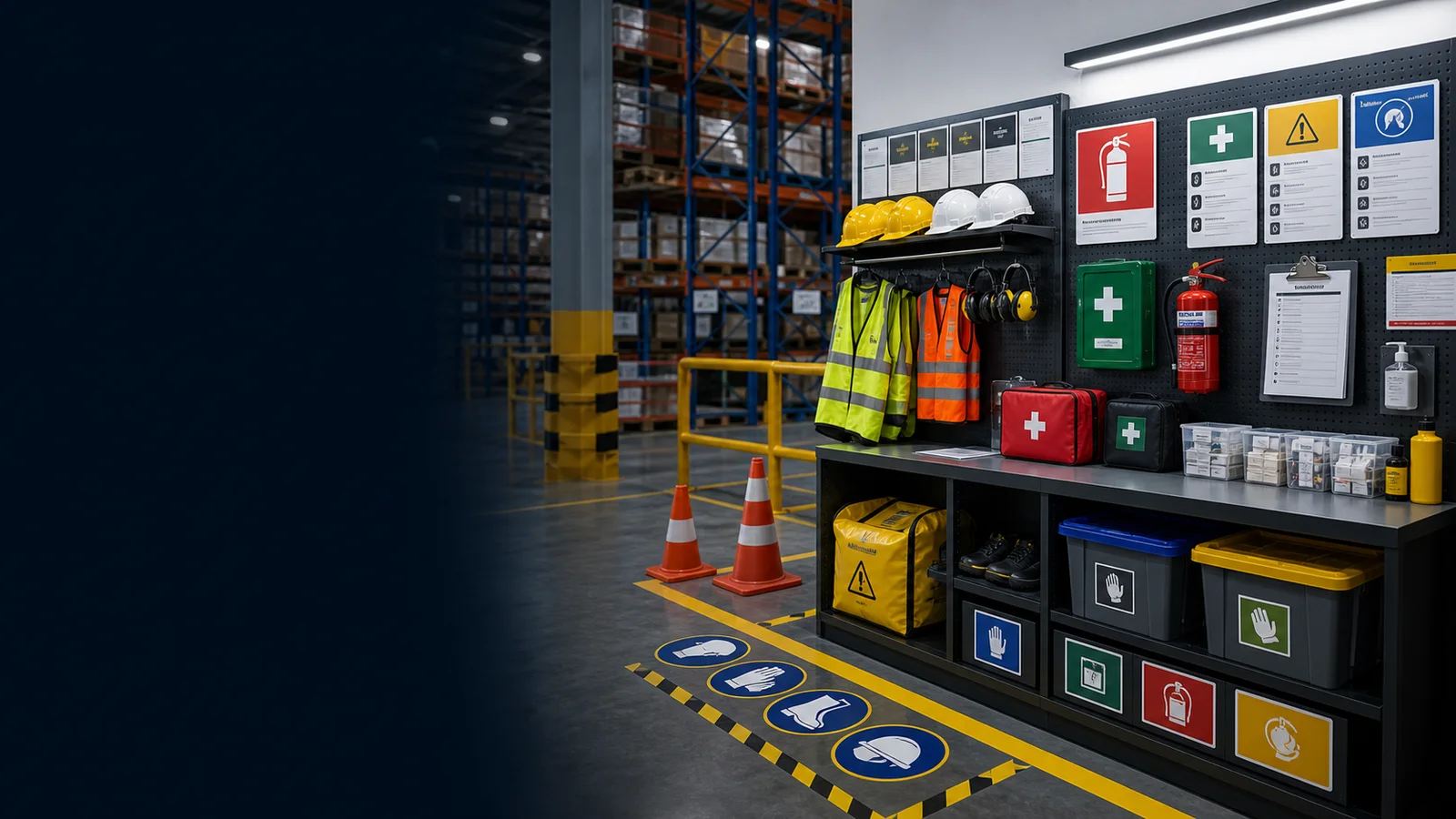
EHS Framework warehouse framework photo

Framework

EHS Framework

Environmental, Health & Safety for warehouse operations. Nine pillars with practical checks, per-pillar progress, filter, export, and print.

Overview

What this framework standardizes

EHS Framework is designed for warehouse teams that need a clear operating method, not just a theoretical document. It explains what supervisors, team leaders, operators, and support functions should look for on the floor, how to convert observations into action, and how to keep the standard alive after the first rollout.

The page focuses on Workplace Hazard Analysis, Assess Risks & Controls, Regulatory Compliance, Education on EHS Practices, Health Monitoring, Ongoing Inspections. These topics help teams align language, reduce variation, and build a repeatable routine that can be audited, trained, and improved over time.

Use this framework as a working reference during shift meetings, Gemba walks, onboarding, improvement workshops, SOP reviews, and daily performance follow-up. The goal is to make the right behavior visible, simple, and repeatable.

6Focus areas
49Floor checks
4Rollout phases

Framework Detail

Operating pillars and practical checks

Each pillar combines a clear intent with practical checks. Use the intent paragraph to explain the standard, then use the checks as audit points, training prompts, or action-plan inputs.

W

Pillar 1

Workplace Hazard Analysis

Identify and analyze potential hazards across workflows to prevent incidents and health issues.

  • Inspect all powered equipment (forklifts, conveyors) for guards, alarms, leaks

  • Map pedestrian vs. vehicle routes; mark crossings and blind spots

  • Identify ergonomic risks (reach, lift, twist, repeat) for key tasks

  • Assess chemical storage/handling areas and labeling (GHS compliant)

  • Check spill sources (oils, coolants, water) and containment readiness

  • Verify battery charging/ventilation zones and signage

  • Confirm racking integrity, load ratings, and damage reporting path

  • Review housekeeping/WIP accumulation against 5S standards

  • Validate emergency egress paths and muster points visibility

A

Pillar 2

Assess Risks & Controls

Evaluate risks and ensure effective controls to mitigate EHS hazards.

  • Perform task-level risk assessments (likelihood × severity)

  • Validate hierarchy of controls selection (eliminate/substitute/engineer/administrative/PPE)

  • Confirm PPE matrix by role and availability/fit

  • Check permit-to-work where required (hot work, confined space, LOTO)

  • Review efficacy of existing controls and update where gaps exist

R

Pillar 3

Regulatory Compliance

Adhere to OSHA/EU/Local regulations, recordkeeping, and inspection readiness.

  • Cross-check procedures with applicable OSHA/EU/Local standards

  • Maintain updated Safety Data Sheets (SDS) and access locations

  • Ensure training records and licenses (e.g., PIT) are current

  • Run internal compliance audits and track findings to closure

  • Prepare inspection binder (policies, logs, drills, reports)

E

Pillar 4

Education on EHS Practices

Educate and reinforce safe behaviors with onboarding and refreshers.

  • Deliver EHS orientation for new hires (hazards, reporting, stop-work)

  • Run hazard recognition and near-miss reporting workshops

  • Conduct toolbox talks / safety stand-downs on recent trends

  • Deploy micro-learning (PPE donning/doffing, ergonomic basics)

  • Publish simple visual SOP/WI at point of use

H

Pillar 5

Health Monitoring

Monitor employee health indicators to prevent occupational illness and injury.

  • Schedule periodic health screenings per risk (hearing, vision, respiratory)

  • Track early signs of MSD/ergonomic strain; adapt tasks where needed

  • Monitor exposure (noise, dust, fumes) and maintain logs

  • Provide access to wellness resources and mental health support

  • Verify hydration/cooling measures for heat stress months

O

Pillar 6

Ongoing Inspections

Run routine inspections and incident learning loops for continuous safety.

  • Perform daily walkthroughs using short standardized job aids

  • Check pre-use inspections logs for PIT and critical tools

  • Ensure defect tags, red-tag areas, and escalation paths are used

  • Capture and analyze near-misses; communicate learnings

  • Verify timely corrective action closure with owners/dates

U

Pillar 7

Update Safety Protocols

Keep protocols and technology current with evolving risks.

  • Review critical procedures at least annually (or post-incident)

  • Integrate regulatory/standard changes within 30 days

  • Adopt proven safety tech (proximity alerts, sensors, vision aids)

  • Update visual controls and floor markings where process changed

  • Version control documents; archive superseded copies

S

Pillar 8

Safety Support Systems

Provide channels, resources, and emergency readiness.

  • Maintain anonymous reporting and rapid feedback loop

  • Keep first-aid stations and AEDs inspected and logged

  • Drill emergency scenarios (fire, chemical, medical) on schedule

  • Ensure spill kits/absorbents are stocked and accessible

  • Confirm after-hours support and incident escalation coverage

E

Pillar 9

Evaluate EHS Effectiveness

Measure results and drive continuous improvement.

  • Track TRIR/LTIR/near-miss rates and visualize monthly trends

  • Measure audit closure timeliness and recurrence rate

  • Survey safety climate; act on themes

  • Review root-cause quality and systemic fixes

  • Present quarterly EHS review with actions/owners

Implementation

How to implement this framework without creating another unused document

01

Diagnose

Understand the current condition

Compare the current warehouse process with the EHS Framework standard. Look for unclear ownership, missing visual controls, repeated questions, rework, waiting time, safety exposure, and places where teams rely on memory instead of a visible rule.

02

Design

Translate the framework into local rules

Turn the guidance into simple local standards: who owns the routine, when it is checked, which evidence is required, and what escalation path is used when the expected condition is not met.

03

Deploy

Train, test, and improve on the floor

Pilot the standard in one area first. Train the team with examples, gather feedback, remove friction, and then expand once the routine works under real workload pressure.

04

Sustain

Review results and prevent drift

Add the topic to daily or weekly management cadence. Track open actions, check whether the standard is still visible, and update SOPs, work instructions, or visual controls when the operation changes.

FAQ

Common questions about EHS Framework

What is EHS Framework?

Environmental, Health & Safety for warehouse operations. Nine pillars with practical checks, per-pillar progress, filter, export, and print.

How should a warehouse team use EHS Framework?

Start with a short review of the current process, select one pilot area, apply the relevant checks, and assign owners for every gap. The page works best when it is used during real floor observation, not only as office documentation.

Why is EHS Framework important for warehouse operations?

It reduces ambiguity and makes execution more consistent. A clear framework helps teams train faster, detect abnormal conditions earlier, and protect improvements from disappearing after volume, staffing, or layout changes.

How often should EHS Framework be reviewed?

Review it during implementation, then include the key points in daily or weekly leadership routines. A deeper review should happen after incidents, layout changes, SOP updates, audit findings, or repeated performance issues.

Created by

Alexandru Valentin Sirbu