The Warehouse Framework by Alexandru Valentin Sirbu
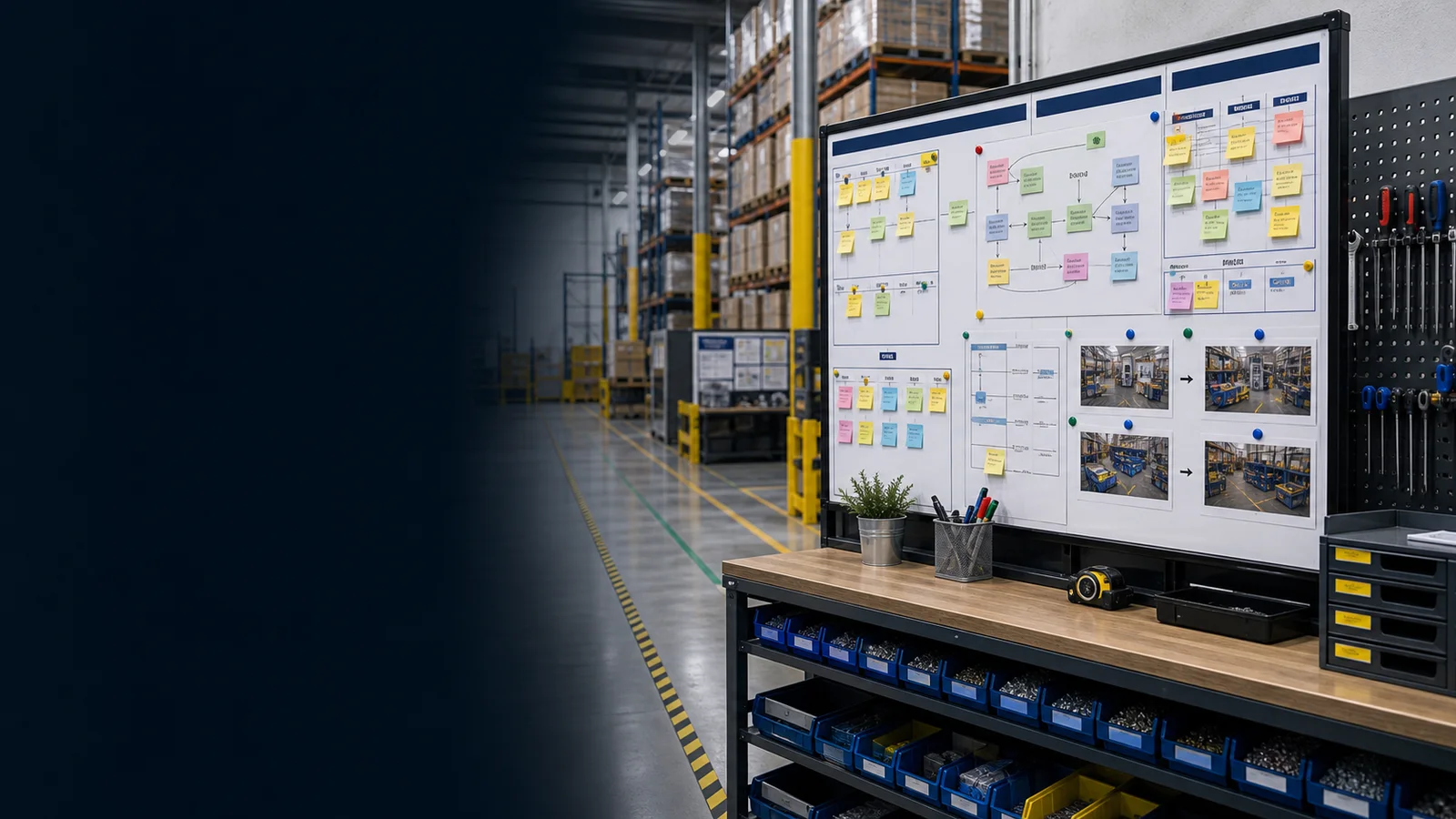
Continuous Improvement warehouse framework photo

Framework

Continuous Improvement

Nine pillars with actionable checks, notes, and progress. Export to Markdown/JSON or print when done.

Overview

What this framework standardizes

Continuous Improvement is designed for warehouse teams that need a clear operating method, not just a theoretical document. It explains what supervisors, team leaders, operators, and support functions should look for on the floor, how to convert observations into action, and how to keep the standard alive after the first rollout.

The page focuses on Waste Elimination, Analyze Processes, Refine Workflows, Engage Employees, Housekeeping (5S), Optimize Operations. These topics help teams align language, reduce variation, and build a repeatable routine that can be audited, trained, and improved over time.

Use this framework as a working reference during shift meetings, Gemba walks, onboarding, improvement workshops, SOP reviews, and daily performance follow-up. The goal is to make the right behavior visible, simple, and repeatable.

6Focus areas
56Floor checks
4Rollout phases

Framework Detail

Operating pillars and practical checks

Each pillar combines a clear intent with practical checks. Use the intent paragraph to explain the standard, then use the checks as audit points, training prompts, or action-plan inputs.

W

Pillar 1

Waste Elimination

Identify and remove the 8 wastes: transportation, inventory, motion, waiting, overproduction, overprocessing, defects, skills.

  • List top 5 wastes by impact

  • Walk the floor and log motion waste

  • Quantify waiting time hotspots

  • Capture rework/defect drivers

  • Define quick wins to remove waste

  • Create owner and due date for each waste

  • Verify financial impact of removals

  • Track waste reductions weekly

A

Pillar 2

Analyze Processes

Use data and observation to find bottlenecks and causes.

  • Map value stream from dock to ship

  • Identify non value-added steps

  • Measure cycle times and WIP

  • Calculate takt time vs. capacity

  • Prioritize constraints by impact

  • Baseline current performance metrics

R

Pillar 3

Refine Workflows

Redesign flows and layouts to cut movement and errors.

  • Redesign layout for shortest paths

  • Balance work across stations

  • Implement pull/Kanban where possible

  • Introduce error-proofing (poka-yoke)

  • Pilot the new workflow on one lane

  • Document changes and SOP updates

E

Pillar 4

Engage Employees

Build a Kaizen culture with frequent involvement.

  • Run weekly Kaizen standups

  • Collect 5 ideas per person per month

  • Create visible idea board

  • Recognize implemented ideas

  • Train on simple PDCA cycles

  • Publish Kaizen newsletter / wins

H

Pillar 5

Housekeeping (5S)

Keep workspace clean and visual for speed and safety.

  • Sort items and remove clutter

  • Set in order with labels and shadows

  • Shine: daily cleaning standard

  • Standardize photos of target state

  • Sustain with weekly audits

  • Fix top 3 audit gaps this month

O

Pillar 6

Optimize Operations

Stabilize flow and improve visibility.

  • Implement visual management boards

  • Level the work where possible

  • Standardize changeover routines

  • Reduce batch sizes where safe

  • Set up andon or alert triggers

  • Track flow health daily

U

Pillar 7

Upgrade Skills

Train and cross-train to lock in improvements.

  • Plan Lean/Kaizen skills training

  • Cross-train key roles for flexibility

  • Teach problem solving (5-Whys, Ishikawa)

  • Upskill on WMS and digital tools

  • Certify standard work adherence

  • Refresh training quarterly

S

Pillar 8

Standardize Improvements

Turn good practice into standard work.

  • Create standard work instructions

  • Add visuals to critical steps

  • Version control SOPs

  • Train and sign-off all roles

  • Add audit checks to GEMBA walks

  • Revise standards after pilots

E

Pillar 9

Evaluate Progress

Measure before/after impact and sustainment.

  • Define lead/lag KPIs for CI

  • Compare pre vs. post metrics

  • Hold monthly CI review

  • Track benefits realized

  • Log lessons learned

  • Plan next PDCA cycle

Implementation

How to implement this framework without creating another unused document

01

Diagnose

Understand the current condition

Compare the current warehouse process with the Continuous Improvement standard. Look for unclear ownership, missing visual controls, repeated questions, rework, waiting time, safety exposure, and places where teams rely on memory instead of a visible rule.

02

Design

Translate the framework into local rules

Turn the guidance into simple local standards: who owns the routine, when it is checked, which evidence is required, and what escalation path is used when the expected condition is not met.

03

Deploy

Train, test, and improve on the floor

Pilot the standard in one area first. Train the team with examples, gather feedback, remove friction, and then expand once the routine works under real workload pressure.

04

Sustain

Review results and prevent drift

Add the topic to daily or weekly management cadence. Track open actions, check whether the standard is still visible, and update SOPs, work instructions, or visual controls when the operation changes.

FAQ

Common questions about Continuous Improvement

What is Continuous Improvement?

Nine pillars with actionable checks, notes, and progress. Export to Markdown/JSON or print when done.

How should a warehouse team use Continuous Improvement?

Start with a short review of the current process, select one pilot area, apply the relevant checks, and assign owners for every gap. The page works best when it is used during real floor observation, not only as office documentation.

Why is Continuous Improvement important for warehouse operations?

It reduces ambiguity and makes execution more consistent. A clear framework helps teams train faster, detect abnormal conditions earlier, and protect improvements from disappearing after volume, staffing, or layout changes.

How often should Continuous Improvement be reviewed?

Review it during implementation, then include the key points in daily or weekly leadership routines. A deeper review should happen after incidents, layout changes, SOP updates, audit findings, or repeated performance issues.

Created by

Alexandru Valentin Sirbu